Call our Alabama Uncontested Divorce Attorneys today at (205) 201-1789

The Harris Firm LLC has finalized Alabama uncontested divorces on the paperwork alone since 2007, filing electronically in all 67 counties from offices in Birmingham, Chelsea, Huntsville, and Montgomery. Phone consultations for uncontested divorce are free; in-person consultations are $100.
In short: An Alabama uncontested divorce is decided on the file, not in a courtroom. The plaintiff’s testimony is submitted as a sworn written statement, the other spouse waives service and consents in writing, and the judge signs the decree after the 30-day waiting period without either spouse appearing. Most of our clients never see the courthouse.
Why it works: Three documents do the job a hearing would otherwise do: the Sworn Testimony of the Plaintiff replaces live testimony, the Answer and Waiver replaces service by a sheriff and the defendant’s appearance, and the Marital Settlement Agreement replaces the judge’s findings on every disputed issue, because nothing is disputed.
The Alabama framework: Alabama Code § 30-2-8.1 sets the 30-day waiting period the judge must observe before signing, and nothing in the divorce statutes requires an in-person hearing when the case is agreed. Circuit courts accept electronically filed pleadings statewide, so the file reaches the judge without anyone walking it in.
The exceptions: A few counties and a few judges still set a brief appearance in specific situations: Madison County in some cases with minor children, Etowah County’s occasional walk-through hearing, and the extra signing formalities in Houston, Jackson, and Mobile Counties. We tell you at the consultation whether your county is one of them.
The Remote Divorce Section and Where to Go Next
What Replaces the Hearing
People are right to ask how a court can end a marriage without anyone testifying. The answer is that in an uncontested case, everything a hearing would accomplish is accomplished on paper, in three documents the judge reviews before signing.
Sworn Testimony of the Plaintiff
A written statement, signed before a notary, in which the filing spouse swears to the facts a judge would otherwise hear from the witness stand: the residency requirement is met, the marriage has broken down, the agreement is voluntary. Filed in place of live testimony.
Answer and Waiver of Service
The other spouse’s signed acknowledgment of the case and waiver of formal service. It eliminates the sheriff or process server and, with it, any need for the defendant to appear and answer in person.
Marital Settlement Agreement
The contract that decides every issue a contested hearing would decide: property, debts, alimony, and, with children, custody, visitation, and support. Because the spouses decided it, the judge has nothing left to hear and only the agreement to review.
Rule 32 Forms (with children)
The CS-41, CS-42, and CS-43 give the judge the income figures and the support calculation in writing, so the one thing courts scrutinize in agreed cases with children is on the desk without a hearing to produce it.
With those four documents in the file, a hearing would only repeat what the judge can already read. That is why Alabama courts sign agreed decrees without one. The step-by-step process shows where each document is prepared and signed.
What Actually Happens Between Filing and the Decree
After we file electronically, the case lands in the assigned judge’s queue with a case number. During the 30-day waiting period, nothing is required of either spouse. The judge, or in busier counties a staff attorney, reads the file: is the residency affidavit complete, is the agreement signed by both, do the child support forms match the agreed figure, is the testimony notarized. If everything checks, the decree is signed on or after day 31.
If something does not check, the court sends a note rather than setting a hearing. A missing initial, a signature dated outside the window Shelby and Montgomery Counties prefer, a support figure that does not match the CS-42. We fix it and resubmit. In our experience the fix is almost always a signature or a form, never a reason to bring the parties in.
Some judges enter an interlocutory decree at filing that becomes final after 30 days; others sign once the 30 days have run. Either way, the decree is entered from chambers, not from the bench.
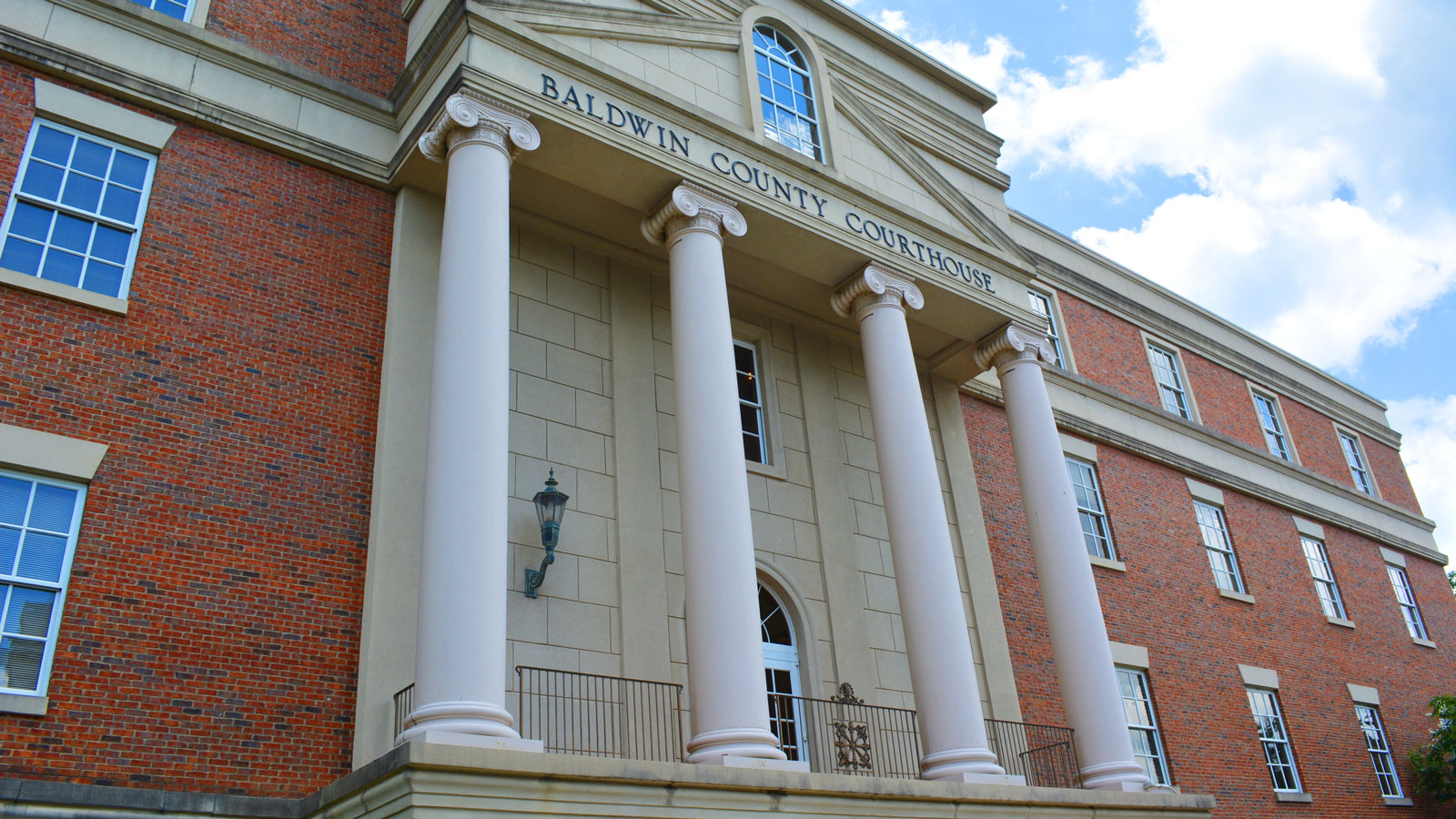
The Baldwin County Courthouse in Bay Minette. Our Baldwin County clients file here from Fairhope, Foley, and Gulf Shores without a courthouse trip; the judge signs the agreed decree from the file.
Where a Short Appearance Can Still Happen
Alabama has 67 circuit courts and several dozen domestic relations judges, and a few of them keep a courtroom step in specific situations. None of these changes the flat fee, and all of them are brief. Here is the honest list.
| County | What can happen | Who attends |
|---|---|---|
| Madison (Huntsville) | Some judges set a short hearing in uncontested cases with minor children, to confirm both parents understand the custody and support terms. Judge-dependent. | Usually the plaintiff, sometimes both. Our Huntsville attorneys appear with you; an attorney appearance fee applies. |
| Etowah (Gadsden) | An occasional “walk-through” hearing before the decree is signed. Judge-dependent. | The plaintiff, with our attorney. Appearance fee applies. |
| Houston (Dothan) and Jackson (Scottsboro) | Specific signing and notarization formalities for the Testimony of the Plaintiff that may involve a brief courthouse step. Not a hearing before the judge. | The plaintiff, for the signing step only. |
| Mobile | A witness affidavit and a court-appointed Commissioner’s certificate are required in addition to the standard documents. Handled as document execution, not a hearing. | The plaintiff and a witness, for signing; we coordinate the Commissioner. |
| Everywhere else | No appearance in the typical uncontested case. | No one. |
The county-by-county filing fee table carries these notes alongside each fee, and we confirm your county’s practice at the free consultation before you retain us.
What a Madison County Hearing Looks Like
Because Madison County is where our clients most often ask this question, here is what the appearance involves when a judge sets one. It runs five to fifteen minutes. The judge confirms on the record that you understand the agreement, that you signed it voluntarily, and, if children are involved, that the custody schedule and support figure are what you agreed to. Occasionally a judge asks a question about the parenting plan. Then the decree is signed, often the same day.
One of our Huntsville attorneys, LaTasha Huffman or Rebecca Lee, appears with you, which is one reason we keep attorneys in Huntsville rather than sending someone from Birmingham. Whether the defendant must attend depends on the judge; often the plaintiff alone is enough. It is a formality with a courtroom attached, not a trial, and it does not change the outcome or the 30-to-60-day timeline in any meaningful way.
The One Thing You Cannot Skip: Agreement
A divorce without going to court is available for exactly one reason: there is nothing for the court to decide. The moment there is, the courtroom comes back. An unresolved issue means a contested divorce, with service on your spouse, a response period, discovery, and eventually a hearing or trial, billed hourly against a retainer starting at $4,000.
So the practical question is not whether you can avoid court. It is whether you and your spouse can finish the agreement. What you must agree on lays out every term, and for most couples the gap between an agreed divorce and a contested one is a single conversation they have not had yet. Have it, and the rest of this page describes your case.
The No-Court Divorce, From Filing to Decree
What happens on the court’s side once your signed documents are in. You are not present for any of it.
Electronic Filing
We file through AlaFile with your county’s Circuit Clerk and pay the filing fee, which you reimburse before submission. The case receives a number and a judge the same day.
The Clerk’s Intake
The clerk checks the filing for completeness and fees. Rejections at this stage are formatting issues; we correct and refile without involving you.
The 30-Day Waiting Period
Alabama Code § 30-2-8.1. Nothing is required of either spouse. In Jefferson County the supporting documents are filed during this window under its two-step sequence.
Judicial Review
The judge reads the testimony, the waiver, the agreement, and any child support forms. If the file is complete, no hearing is set.
Corrections, if Any
A question from chambers comes to us, not to you. A signature, a date, or a form is corrected and resubmitted.
The Decree
Signed from chambers on or after day 31. We are notified through the e-filing system and send both spouses the decree, with certified copies to follow.
Divorce Without Going to Court FAQs
1.Do I have to go to court for an uncontested divorce in Alabama?
In the typical case, no. The plaintiff’s testimony is submitted as a sworn written statement, the other spouse signs an Answer and Waiver, and the judge signs the decree from the paperwork after the 30-day waiting period. A few counties and judges set a brief appearance in specific situations, most often Madison County in cases with minor children, and we tell you in advance if your county is one of them.
2.How can a judge grant a divorce without hearing testimony?
Because the testimony is in the file. The Sworn Testimony of the Plaintiff is a notarized written statement covering everything a judge would ask from the witness stand, and the Marital Settlement Agreement resolves every issue the court would otherwise decide. Alabama law does not require a live hearing when the case is agreed and the paperwork is complete.
3.Does my spouse have to appear or be served?
No. Your spouse signs an Answer and Waiver of Service before a notary, which acknowledges the case and waives formal service. That removes both the sheriff or process server and any need for your spouse to appear. The waiver can be signed anywhere, including in another state.
4.Which Alabama counties might require a hearing?
Madison County judges sometimes set a short hearing in uncontested cases with minor children. Etowah County occasionally holds a walk-through hearing. Houston, Jackson, and Mobile Counties have extra signing formalities for the testimony that are not hearings before the judge. Every other county finalizes the typical uncontested case without an appearance.
5.What happens if a hearing is required in my case?
It is brief, usually five to fifteen minutes, and one of our attorneys appears with you. The judge confirms you understand and voluntarily signed the agreement and, with children, that the custody and support terms are what you agreed to. An attorney appearance fee applies, and the decree is often signed the same day.
6.Is a divorce without going to court still a real, final divorce?
Yes. The decree the judge signs from the file is the same Final Decree of Divorce entered after a hearing, with the same legal effect. It ends the marriage, adopts your settlement agreement as a court order, and is enforceable exactly like any other decree.
Four Offices, Every Alabama County
Finish Your Divorce Without a Courtroom
One free phone call confirms your county’s practice, screens for anything that would require an appearance, and quotes your exact total. For most clients the answer is the same: sign, we file, the judge signs.
The Flat Fee Covers
✓ Sworn testimony, waiver, and settlement agreement drafted and coordinated
✓ Electronic filing and every clerk or judge follow-up
✓ Attorney handling of any corrections during the waiting period
✓ Certified copies of the Final Decree mailed to both spouses
$690 plus filing fee without minor children · $890 plus filing fee with minor children
Call the Office Nearest You
Birmingham: (205) 201-1789
Chelsea: (205) 677-5490
Huntsville: (256) 665-9473
Montgomery: (334) 782-9938
Wondering whether your case qualifies? Start with Do I Qualify.
Harris Firm LLC Proud Member of