


In Alabama, a divorce case does not always move forward with both spouses actively participating. Sometimes one spouse files for divorce, properly serves the other party, and then hears nothing back. When that happens, the court process may continue through what is commonly called a default divorce. A default divorce can be an important legal tool because it prevents one spouse from delaying the end of the marriage simply by refusing to respond. Although the process may sound straightforward, Alabama courts still require strict compliance with procedural rules before a judge will enter a final decree.
A default divorce begins like any other divorce action. One spouse files a complaint for divorce with the appropriate circuit court and asks the court for certain relief, such as a division of marital property, alimony, or custody orders involving the children. Before the court can act, however, it must first have jurisdiction. In Alabama, that usually means meeting residency requirements and filing in the proper county. If both spouses live in Alabama, jurisdiction is generally easier to establish. But if the defendant lives outside Alabama, the spouse filing the complaint must usually have been a bona fide resident of Alabama for at least six months before filing. Courts take this requirement seriously, and failure to meet it can create major problems with the validity of the divorce.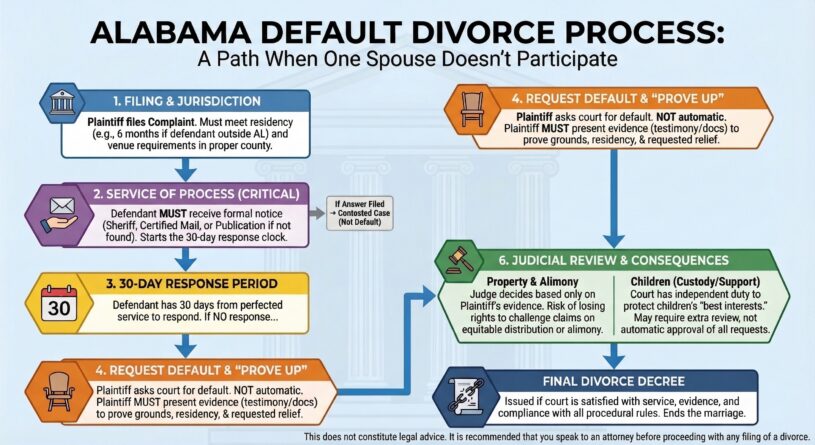
Venue is also important. In most cases, a divorce should be filed in the county where the defendant resides or where the parties last lived together before separating. If the defendant does not live in Alabama, the filing spouse may generally file in the county where he or she resides. Although filing in the wrong venue does not always destroy the case, it can lead to delays or a transfer to another court. In a default divorce, those delays can be especially frustrating because the filing spouse is often hoping to move the case forward as quickly as possible.
Once the complaint is filed, the next critical step is service of process. Alabama law requires the defendant to receive proper legal notice of the divorce action. Service may be completed by sheriff, private process server, or certified mail, depending on the circumstances. The 30-day response period begins when service is perfected. If the defendant is personally served, the clock starts on the date the paperwork is handed over. If service is made by certified mail, the response period generally begins when the defendant signs for it. Without valid service, the court cannot move forward with a default judgment.
In some cases, the defendant cannot be found. Alabama law allows service by publication when a spouse cannot be located despite diligent efforts. This typically requires the filing spouse to submit an affidavit explaining the attempts made to locate the missing spouse. Notice is then published in an approved newspaper for the required period. Service by publication can be enough to allow the divorce itself to proceed, but it may limit what other relief the court can grant, especially if the court lacks personal jurisdiction over the defendant. That means a default divorce obtained through publication may not always result in the same kind of financial orders that could be entered if the defendant had been personally served.
If the defendant does not file an answer or other response within 30 days after proper service, the filing spouse may ask the court to enter a default. This is not the same thing as an automatic divorce. Alabama courts do not simply grant a divorce because one spouse failed to answer. Instead, the plaintiff must still prove the case. The court usually requires testimony or written evidence establishing the grounds for divorce, residency, and other facts necessary to support the relief requested. This step is often called “proving up” the case. It exists to protect against improper or fraudulent divorce decrees and to ensure the requested relief is lawful and fair.
A default divorce also remains subject to Alabama’s mandatory waiting period. Even if the other spouse never responds, the judge still cannot sign the final decree until at least 30 days have passed after the complaint is filed. This waiting period applies in divorce cases generally and is one reason the process does not become immediate just because the defendant defaults. Even after the 30 days expire, the timing of the final decree often depends on the court’s schedule and how quickly the file is reviewed.
When property division is involved, a default can have serious consequences for the non-responding spouse. Alabama follows the principle of equitable distribution, which means marital property is divided fairly, though not necessarily equally. If one spouse does not participate, the judge may have only the filing spouse’s evidence when deciding how to divide the marital estate. That can include information about bank accounts, real estate, retirement funds, debts, and personal property. A spouse who ignores the case risks losing the opportunity to challenge the other party’s claims or present a different view of what would be fair.
The same is true when one spouse seeks financial support. A court may award Alimony in Alabama in a default judgment if the evidence supports such relief. Alabama law often favors rehabilitative alimony, which is intended to help a spouse transition toward financial independence for a limited period of time. In deciding whether alimony is appropriate, courts may consider factors such as the length of the marriage, the earning abilities of the parties, and the standard of living established during the marriage. If the responding spouse fails to appear or answer, he or she loses the chance to present evidence on these important issues.
Default divorces can also involve children, but courts are especially cautious when custody and support are at issue. A judge is not required to grant everything requested simply because the other spouse failed to respond. Instead, the court still has an independent duty to protect the best interests of the children. For that reason, default cases involving custody, support, and visitation may require additional documentation and careful review. By contrast, an uncontested divorce typically involves both spouses agreeing to all major terms in advance, which often makes the process smoother and less adversarial.
A default divorce serves an important purpose in Alabama family law. It allows the judicial system to move forward even when one spouse refuses to participate. But default does not mean automatic. The filing spouse must still satisfy residency requirements, properly serve the defendant, wait the required time, and present evidence sufficient for the court to grant relief. Because the consequences of a default judgment can be significant, anyone pursuing this type of divorce should make sure the case is handled carefully and in full compliance with Alabama law.

Attorney Steven A. Harris regularly blogs in the areas of family law, probate, and estate planning on this website. Mr. Harris tries to provide informative information to the public in easily digestible formats. Hopefully you enjoyed this article and feel free to supply feedback. We appreciate our readers & love to hear from you!